

Buy Acepromazine Maleate Injection 50ml / Phenothiazine Tranquilizer Online: The Definitive Guide to Veterinary Sedation, Pharmacology, and Clinical Management
Managing fractious behavior, minimizing stress during transport, controlling intractable animals during clinical examinations, and providing reliable pre-anesthetic sedation in dogs, cats, and horses requires a rapid-acting central nervous system depressant. When animals experience high anxiety, minor surgical stress, or require chemical restraint, precise neuroleptic intervention is essential to ensure handler safety, reduce general anesthetic requirements, and maintain smooth patient management.
Left unmanaged, high stress and fractious behavior increase the risk of physical injury to both the animal and handler during routine veterinary procedures, grooming, or transport.
Relying solely on behavioral handling is frequently insufficient for highly stressed, anxious, or uncooperative large and small animals.
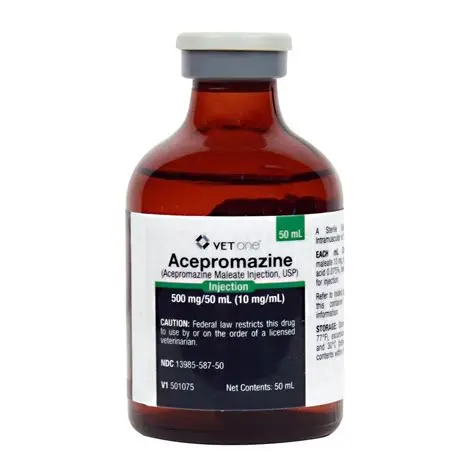
To provide prompt, dependable calming action backed by decades of veterinary clinical validation, practitioners rely on gold-standard neuroleptic solutions. Acepromazine Maleate Injection is a premier, professional-grade sedative and pre-anesthetic agent powered by Acepromazine Maleate. Packaged in a multi-dose glass vial, it delivers targeted central nervous system depression engineered specifically for advanced multi-species veterinary practice.
Neuroleptic Pharmacology & Kinetic Profile
Acepromazine delivers a targeted biochemical mechanism engineered to block central dopaminergic receptors, reduce spontaneous motor activity, and induce profound muscle relaxation:
             [Acepromazine Maleate Injection 10 mg/mL Administered (IV, IM, or SC)]
                                              |
               [Systemic Distribution and Blockade of Central Dopaminergic Receptors]
                                              |
               -------------------------------------------------
              |                                                 |
     [CENTRAL NERVOUS SYSTEM DEPRESSION]         [ALPHA-1 ADRENERGIC BLOCKADE]
    (Reduces Spontaneous Activity & Anxiety)     (Produces Peripheral Vasodilation)
              |                                                 |
              v                                                 v
     [Calming & Sedative Response]               [Hypotensive & Antispasmodic Effect]
   (Facilitates Handling & Restraint)            (Lowers Blood Pressure & Vascular Resistance)
              |                                                 |
              v                                                v
     [Pre-Anesthetic Potentiation]               [Anti-Emetic & Antiemetic Action]
   (Reduces Barbiturate/Anesthetic Doses)        (Controls Motion Sickness & Vomiting)
              |                                                 |
               =========================> <=====================
                                              |
                                              v
                   [Complete Behavioral Tranquilization and Muscle Relaxation]
                                              |
                   [Safe Clinical Examination, Transport, and Surgical Preparation]
1. Mechanism of Action and Neuroleptic Structure
Acepromazine Maleate Injection is a potent phenothiazine derivative neuroleptic agent. It exerts its primary sedative effect by blocking central dopamine receptors in the brain. Additionally, it blocks peripheral alpha-adrenergic receptors, leading to peripheral vasodilation, a reduction in blood pressure, and an absence of primary analgesic properties (meaning pain management must be supplemented separately if painful procedures are performed).
2. Pharmacokinetic Onset and Duration
Rapid Systemic Absorption: When administered via intravenous ($\text{IV}$) injection, calming effects manifest within 5 to 8 minutes. Intramuscular ($\text{IM}$) or subcutaneous ($\text{SC}$) administration produces onset within 15 to 25 minutes.
Duration of Action: Clinical tranquility typically persists for 4 to 6 hours in small animals, though metabolic clearance can take up to 24 hours depending on liver and kidney function.
Acepromazine Maleate Injection Primary Clinical Indications
Acepromazine Maleate Injection is indicated across veterinary medicine for multi-species sedation and restraint:
Pre-Anesthetic Sedation: Used prior to general anesthesia to smooth induction, reduce the required dose of general anesthetics, and provide muscle relaxation.
Chemical Restraint and Handling: An aid in controlling fractious or intractable dogs, cats, and horses during clinical examinations, treatments, grooming, radiographs, and minor surgeries.
Transport and Travel Calming: Alleviates travel anxiety and fractious behavior during loading and transportation in equine and livestock operations.
Antiemetic Support: Helps control vomiting associated with motion sickness in small animals.
Acepromazine Maleate Injection Recommended Administration and Dosing Protocols
To guarantee absolute safety, proper systemic distribution, and patient monitoring compatibility, Acepromazine Maleate Injection must be administered strictly according to approved route and weight-based guidelines.
Acepromazine Maleate Injection Dosing Reference Table
The table below outlines standard operational parameters for Acepromazine Maleate Injection ($10\ \text{mg/mL}$):
| Target Species | Administration Route | Standard Dosage Rate | Clinical Application Focus |
| Dogs | Intravenous ($\text{IV}$), Intramuscular ($\text{IM}$), or Subcutaneous ($\text{SC}$) | $0.25$ to $0.5\ \text{mg/lb}$ ($0.05$ to $0.1\ \text{mL}$ per $10\ \text{kg}$) | Pre-anesthetic sedation, restraint, antiemetic |
| Cats | Intramuscular ($\text{IM}$) or Subcutaneous ($\text{SC}$) | $0.5$ to $1.0\ \text{mg/lb}$ ($0.5$ to $1.0\ \text{mL}$ per $10\ \text{kg}$) | Examination, minor treatment restraint, pre-anesthetic |
| Horses | Deep Intramuscular ($\text{IM}$) or Slow Intravenous ($\text{IV}$)* | $2$ to $4\ \text{mg}$ per $100\ \text{lbs}$ ($0.05$ to $0.1\ \text{mL}$ per $10\ \text{kg}$) | Control during transport, shoeing, clipping, and surgery |
*Note: Stallions should receive intramuscular administration only, adhering strictly to minimum effective doses to prevent permanent retractor penis muscle paralysis.
Clinical Safety, Precautions, and Storage
Hypotension and Cardiovascular Risks: Acepromazine induces peripheral vasodilation which can lead to significant drops in blood pressure. Avoid rapid intravenous injection to prevent cardiovascular collapse. Epinephrine is contraindicated for treating hypotension induced by phenothiazines.
Breed Sensitivities: Giant breeds, Greyhounds, Boxers, and herding breeds carrying the $\text{MDR1}$ ($\text{ABCB1}$) genetic mutation (such as Collies and Australian Shepherds) exhibit heightened sensitivity to phenothiazines, requiring significantly reduced dosages. Boxers are particularly susceptible to severe bradycardia and syncope.
Storage Parameters: Store unopened and punctured vials at controlled room temperatures between 20°C and 25°C (68°F to 77°F), with permitted excursions between 15°C and 30°C (59°F to 86°F). Protect from direct light.
Acepromazine Maleate Injection Frequently Asked Questions (FAQ)
What is the active ingredient in Acepromazine Maleate Injection?
The active pharmaceutical ingredient is Acepromazine Maleate at a concentration of $10\ \text{mg/mL}$ in a sterile multi-dose aqueous solution.
What animals can be treated with Acepromazine Injection?
It is officially labeled and approved for use as a tranquilizer and pre-anesthetic in dogs, cats, and horses.
Does Acepromazine provide pain relief?
No. Acepromazine is a neuroleptic tranquilizer and sedative; it does not possess analgesic properties. Pain control must be added separately if performing painful interventions.
Where can I buy genuine Acepromazine Maleate Injection 50ml online?
You can safely source authentic, pharmaceutical-grade Acepromazine Maleate Injection ($50\ \text{mL}$ vial) online through Global Vet Care. We store all prescription veterinary sedatives and injectables under rigorous climate-controlled conditions to guarantee absolute product freshness, safety, and full potency.
Secure Professional Sourcing from Global Vet Care
At Global Vet Care, we understand that managing animal restraint, surgical preparation, and transport stress requires absolute product reliability and strict adherence to pharmaceutical standards. Every vial of Acepromazine Maleate Injection is procured through authorized veterinary distribution networks, stored in our climate-controlled facility, and handled with precision.
ACEPROMAZINE Maleate Injection is used for sedation, tranquilization and as a pre-anesthetic agent in horses, dogs and cats.
Description
Acepromazine Maleate Injection is used for sedation, tranquilization and as a pre-anesthetic agent in horses, dogs and cats. Each ml contains 10 mg Acepromazine Maleate. Can be used as an aid in controlling animals during examination, treatment and minor surgical procedures. Maleate has a depressant effect on the central nervous system and therefore causes sedation, muscular relaxation and a reduction in spontaneous activity. It acts rapidly, exerting a prompt and pronounced calming effect. It is an effective pre-anesthetic agent and lowers the dosage requirement of general anesthetics.
Acepromazine Maleate Injection may be given intravenously, intramuscularly or subcutaneously. The general dosage of Maleate Injection for horses is 2-4 mg per 100 lbs body weight; dogs 0.25-0.5 mg per lb body weight; for cats 0.5-1.0 mg per lb body weight.
Not for use in animals hypersensitive (allergic) to it or other phenothiazines. Use with caution in debilitated or geriatric animals and those with liver or heart disease. Do not use in pregnant or lactating animals (female animals nursing their young) unless benefits outweigh the risks. Do not use in animals with hypovolemia (low blood volume), anemia, or shock. Do not use in animals with tetanus or strychnine toxicity. May cause seizures. Do not use with animals known to have seizures or are having medical procedures known to cause seizures (e.g., myelograms). When used to aid in restraint, the sedative effect can be overridden and the animal may bite or jump unexpectedly. Promace is an inappropriate medication for the treatment of aggression since it can make aggressive animals less predictable, and can interfere with training. Causes low blood pressure and inability to maintain proper body temperature. ACEPROMAZINE ACEPROMAZINE ACEPROMAZINE ACEPROMAZINE
Does not provide any pain relief. Giant breeds, greyhounds, and boxers may be more sensitive to its effects; terriers may be less sensitive. Effects may last 6-8 hours, and results may not be consistent when given orally. Consult with your veterinarian regarding the physical examinations and laboratory testing necessary prior to and during treatment with promace.
Drug, Food, and Test Interactions:
Consult your veterinarian before using promace with vitamins, supplements, atropine, central nervous system (CNS) depressant drugs (such as barbiturates, narcotics, and antidepressants), organophosphate dewormer or insecticide, kaopectate, Pepto-Bismal, other antidiarrheal mixures, antacids, propranolol, and epinephrine. May have an adverse heart reaction if used with quinidine. Phenytoin levels and procaine activity may be increased if used with promace.




























Reviews
There are no reviews yet.