

Buy Isoflurin 250ml Online: The Definitive Veterinary Guide to Isoflurane Inhalation Anesthesia, Minimum Alveolar Concentration (MAC) Protocol, and Patient Management
In modern veterinary surgery, companion animal medicine, and equine hospital operations, volatile inhalation anesthesia represents the standard of care for general surgical procedures. Unlike injectable anesthetics—which depend on hepatic metabolism and renal excretion—inhalation vapors afford the clinician minute-by-minute control over depth of anesthesia. This specialized control lowers the risk of prolonged drug accumulation and shortens post-anesthesia recovery times.
Among modern inhalation agents, Isoflurane remains widely utilized due to its stable cardiovascular profile, minimal tissue metabolism, and rapid clearance properties.
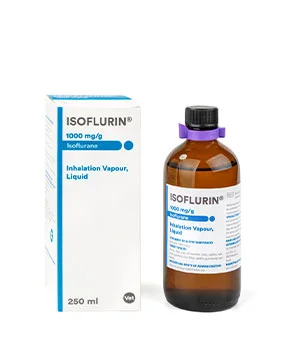
Isoflurin 250ml provides pure Isoflurane (1000 mg/g) as a clear, colorless liquid intended for delivery via an agent-specific calibrated vaporizer. By establishing stable partial pressures within alveolar gas and central nervous system tissues, Isoflurin suppresses cerebral cortical pathways, enabling safe, controlled general anesthesia for small, large, and exotic animal patients.
This comprehensive clinical reference guide details the neurological pharmacology, Minimum Alveolar Concentration (MAC) dynamics, vaporizer administration pathways, and surgical safety parameters for Isoflurin 250ml.
1. Neurochemical Pharmacology and Systemic Mechanisms
Isoflurane is a halogenated ether compound that acts as a potent central nervous system depressant.
                      [Isoflurin 250ml Liquid Volatilization]
                                         |
                     [Inhalation via Calibrated Vaporizer Circuit]
                                         |
                        [Alveolar Gas-Blood Equilibration]
                                         |
                     [Crosses the Blood-Brain Barrier (BBB)]
                                         |
                 -------------------------------------------------
                |                                                 |
     [GABA-A Receptor Activation]                     [Glutamate Pathway Block]
                |                                                 |
     (Hyperpolarizes Target Neurons)                 (Suppresses NMDA Receptors)
                |                                                 |
                v                                                 v
     [Inhibition of Motor Pathways]                  [Loss of Consciousness/Pain]
                |                                                 |
                 ------------------------> <----------------------
                                        |
                                        v
                    [Reversible State of General Anesthesia]
Modulation of GABA-A and NMDA Receptors
At the cellular level, Isoflurane modifies synaptic neurotransmission within the central nervous system by altering lipid bilayers and transmembrane ion channels:
Potentiating Inhibitory Pathways: It binds to GABA-A (gamma-aminobutyric acid type A) and glycine receptors, keeping chloride channels open longer. The resulting influx of chloride ions hyperpolarizes neurons, reducing their capacity to fire electrical impulses.
Suppressing Excitatory Pathways: It inhibits nicotinic acetylcholine and NMDA (N-methyl-D-aspartate) receptors, blocking excitatory glutamate signals. This combined action blocks sensory inputs, prevents motor responses to painful stimuli, and induces a reversible state of unconsciousness.
Cardiorespiratory Dynamics
Vasodilation: Isoflurane induces a dose-dependent decrease in systemic blood pressure, primarily driven by peripheral vasodilation rather than direct cardiac muscle depression.
Ventilatory Drive: It reduces tidal volume and alters respiratory drive. Spontaneous ventilation must be carefully monitored, and positive-pressure mechanical ventilation should be readily available if required.
2. Minimum Alveolar Concentration (MAC) Guidelines
The Minimum Alveolar Concentration (MAC) represents the standard measure of potency for inhalation anesthetics. It is defined as the concentration of vapor in the alveoli needed to prevent gross muscular movement in 50% of subjects exposed to a painful stimulus.
Potency values vary between species, demanding precise vaporizer calibration:
| Target Species Class | Baseline MAC Value (Pure Oxygen) | Target Induction Range (%) | Surgical Maintenance Range (%) |
| Dogs (Canine) | 1.28% to 1.39% | 3.0% to 5.0% | 1.5% to 2.5% |
| Cats (Feline) | 1.28% to 1.63% | 3.0% to 4.0% | 1.5% to 2.5% |
| Horses (Equine) | 1.31% to 1.50% | 3.0% to 5.0% | 1.5% to 2.0% |
| Birds (Avian) | 1.34% to 1.45% | 2.5% to 3.5% | 1.3% to 2.0% |
Clinical Note: MAC requirements decrease when combined with pre-anesthetic sedatives or analgesic infusions (opioids, alpha-2 agonists), allowing lower vaporizer settings and improving cardiovascular stability.
3. Vaporizer Filling and Clinical Setup Protocol
To prevent environmental contamination and ensure accurate delivery, Isoflurin must be managed with precise procedural protocols.
4. Clinical Safety, Precautions, and Withdrawal Windows
Malignant Hyperthermia Risk: In rare cases, halogenated inhalants can trigger malignant hyperthermia in susceptible individuals (most notably certain swine lineages). Discontinue use immediately and initiate cooling protocols if rapid temperature spikes occur.
Occupational Health Exposure: Chronic exposure to waste anesthetic vapors can pose health risks to clinical staff. Always use a validated active or passive scavenging system in the surgical suite.
Hypothermia Susceptibility: Volatile gases suppress the hypothalamic thermoregulatory center. Ensure active patient warming measures (such as warm-water blankets or forced-air warmers) are deployed during surgery.
Food Safety Withdrawal Periods
When utilized for surgical interventions in food-producing livestock, adhere strictly to these consumer safety timelines:
| Animal Classification | Meat & Slaughter Withdrawal Time | Milk Withholding Period |
| Horses (Equine Stock) | 2 Days from last exposure | N/A |
| Cattle (Bovine Stock) | 2 Days from last exposure | 60 Hours (5 complete milkings) |
5. Frequently Asked Questions (FAQ)
What is the active ingredient concentration in Isoflurin 250ml?
Isoflurin contains 1000 mg/g of pure Isoflurane. It features no added stabilizing agents, ensuring high chemical purity and clean volatilization within the anesthetic circuit.
Can Isoflurin be given via direct intravenous injection?
No. Isoflurin is a highly volatile liquid that must never be injected. It is designed strictly to be loaded into an agent-specific vaporizer, where it is converted into an inhalation gas and blended with oxygen or nitrous oxide.
Why is an active gas scavenging system necessary?
Anesthetic vapors exhaled by the patient can enter the room air. A scavenging system captures this excess gas, protecting veterinary surgeons and assistants from unintended exposure and headaches.
Where can I buy verified Isoflurin 250ml online?
You can safely buy authentic, factory-sealed Isoflurin 250ml online via Global Vet Care. Every bottle is managed in our climate-regulated facility and shipped securely to ensure full clinical potency upon arrival.
6. Professional Pharmacy Distribution from Global Vet Care
At Global Vet Care, we understand that high-precision surgical agents require impeccable storage parameters. Every container of Isoflurin 250ml is housed within our modern, temperature-monitored pharmaceutical hub to guarantee chemical sterility, long shelf-life, and complete diagnostic value.
Isoflurin 250ml PHARMACOLOGICAL PROPERTIES
Anesthetic, Isoflurin 250Ml produces unconsciousness due to its effect on the central nervous.
Anesthetic and Sedative, recommended for all More information:Isoflurin 250ml
LABORATORIO
FATRO IBÉRICA
PHARMACEUTICAL FORM
Liquid for vapor inhalation (Liqu.inh.vap.)
PHARMACOLOGICAL PROPERTIES
Isoflurin 250ml Anesthetic, isoflurane produces unconsciousness due to its effect on the central nervous system. It has little or no analgesic property.
Like other anesthetics by inhalation of this type, isoflurane depresses the respiratory and cardiovascular systems. Isoflurane is absorbed during inhalation and is rapidly distributed through the bloodstream to other tissues, including the brain.
INTERACTIONS AND INCOMPATIBILITIES
• Isoflurin 250ml enhances the effect of muscle relaxants in men, especially non-depolarizing (competitive) types such as atracurium, pancuronium or vecuronium.
Isoflurin 250 Ml
Anesthetic and Sedative, recommended for everyone
More information:
LABORATORY
FATRO IBÉRICA
PHARMACEUTICAL FORM Isoflurin 250ml
Steam inhalation liquid (Liqu.inh.vap.)
COMPOSITION BY MG / G:
Isoflurane 1000 mg / g.
PHARMACOLOGICAL PROPERTIES Is
Anesthetic, isoflurane produces unconsciousness due to its effect on the central nervous system. It has few or no analgesic properties.
INTERACTIONS AND INCOMPATIBILITIES Is
be degraded into carbon monoxide using dry carbon dioxide absorbers.
INDICATIONS
Horses, Dogs, Cats, Ornamental Birds, Reptiles, Rats, Mice, Hamsters, Chinchillas, Gerbils, Cobayas and Ferrets: Induction and maintenance of general anesthesia.
CONTRAINDICATIONS
• Do not use in case of known susceptibility to malignant hyperthermia.
• Do not use in case of hypersensitivity to the active substance.
ADVERSE REACTION
mlcauses hypotension and respiratory depression in a dose-related manner
ROUTE OF ADMINISTRATION I
Isoflurane should be administered using a properly calibrated vaporizer in a suitable anesthetic circuit, since anesthesia levels could be altered quickly and easily.
COMPOSITION: Each gram contains
. DESTINATION SPECIES Horses, dogs, cats, ornamental birds, reptiles, rats, mice, hamsters, chinchillas, gerbils, guinea pigs and ferrets. INDICATIONS Induction and maintenance of general anesthesia. CONTRAINDICATIONS Do not use in case of known susceptibility to malignant hyperthermia.Do not use in case of hypersensitivity to the active substance. POSOLO













Reviews
There are no reviews yet.